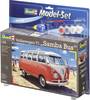
The origin of all today's vans and vans is the plate wagons used for in-plant transport in Volkswagen's Wolfsburg production facility in the late 1940er, which inspired Dutch importer Ben Pon to an idea of a transport vehicle. At the end of the 1940er, VW developed several prototypes for a large-scale vehicle suitable for transport purposes. Since none of the names initially requested could be used without restriction, the new vehicle class was given the name Transporter. From March 8, 1950, the first-generation van was manufactured in series. The car with the typical V-shaped front section and the split windscreen was available in various versions, including as a small bus. The technology was based on that of the Volkswagen Type 1, the so-called Beetle, so that the T1 had an air-cooled four-cylinder boxer engine. The performance of the reliable 1.2 liter rear engine increased from 1961 to 34 hp The luxury version of the small bus, the nine-seater special model, is still known as the Samba bus and is used with oval roof windows, very comfortable seats, a folding roof and a very large number of chrome parts to create a distinctive car-like charm.Thanks to all the movable doors, the kit allows a deep insight into the spacious interior. In line with the great demand in the USA, the European or American version can be built.
This text is machine translated.