"Monacor")
For beginners: What is PA technology (ELA) or 100-volt technology?
ELA stands for ‘electroacoustic system’ or ‘electric loudspeaker system’. In technical jargon, such systems are often referred to as ‘public address systems’. Originally, ELA systems were used primarily to convey information. Today, however, they are also used in commercial settings – for example, to play background music, for voice transmission in schools and supermarkets, or for voice alarm systems.
Fun fact: ELA systems almost always operate on the principle of 100-volt technology. Consequently, the term ‘ELA’ is frequently used in everyday language as a synonym for 100-volt technology, leading to terms such as ‘ELA loudspeakers’ or ‘ELA speaker units’. Further information on our ELA loudspeakers can be found at www.monacor.de/ela-lautsprecher.
Current bestsellers
Advantages of PA technology or 100-volt technology:
-
Efficiency and cost-effectiveness: Audio signals are transmitted over long distances with virtually no loss via cables with a small cross-section. This results in lower voltage losses over long distances compared with low-impedance systems. The use of cables with a smaller cross-section reduces material costs and increases the cost-effectiveness of the entire system.
-
Easy installation: Speakers can be easily integrated into a parallel circuit.
-
Tidy cabling: No tangled cables, even with lots of speakers in large spaces.
-
Flexible and expandable: Speakers can be added at a later date with ease.
-
Longer cable lengths: Greater range without any loss of quality compared with low-impedance systems.
-
No impedance issues: A simple circuit that does not require the termination impedance to be taken into account or calculated.
Conclusion: ELA / PA technology or 100-volt technology is ideal for installations across large areas with long cable runs that require flexibility and efficiency.
The right sound: speakers and amplifiers must be compatible
You’ll achieve the best results from your ELA system when the speakers and amplifier are perfectly matched – with the right power output and the necessary features, such as mute or volume controls for multi-room sound systems. Ensure that the amplifier’s wattage matches the power handling of the speakers to guarantee optimum performance. For multi-channel systems, it is advisable to choose speakers from the same brand to guarantee maximum harmony and compatibility. You can find inspiration for our perfectly matched sound systems in our Commercial Audio Solutions brochure.


PA amplifiers: Unobtrusive but indispensable – a comparison of power amplifiers
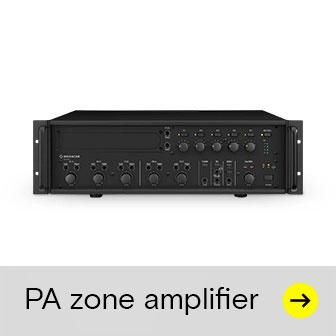
The PA amplifier is the silent heart of any sound system. Whilst the audience hears only the sound from the loudspeakers, the amplifier works behind the scenes to ensure reliable and powerful signal transmission – whether in small pubs, large office complexes or conference rooms. It remains unobtrusive, yet fulfils an essential task: the optimal amplification of announcements, music or microphone sound.
Our PA amplifiers offer:
-
Reliable performance: They deliver full power at all times for public address announcements, voice alarms or music playback – without any loss of power.
-
Robust construction: Our amplifiers are designed for demanding, continuous use and offer reliability in all applications, from conferences to readings and panel discussions.
-
Ease of use: Despite the advantages of digital technology, our interface remains simple and intuitive – ideal for users who do not require complex functions. This means fewer sources of error and clear, straightforward operation, even for end users with no prior technical knowledge.
We make the most of digital technology, but deliberately avoid unnecessary, complex features that might make the amplifier difficult to use. This ensures the amplifier remains easy to use whilst still delivering high performance – a reliable solution for any sound system.

Analogue power amplifiers
Optimised over decades
Easier to use
Digital amplifiers are more complex and consist of more components than analogue public address amplifiers.
Easier to repair
Troubleshooting is simpler with analogue devices, particularly for users with a basic knowledge of electronics.
Ideal for vintage devices
Perfect for connecting to
record players or old-school radios.

Digital power amplifiers
Compact and efficient
Increased efficiency (approx. 90%)
Significantly better than analogue Class AB amplifiers (50–70%), which means energy is used more efficiently.
Compact design
The high efficiency allows for a
smaller and lighter design.
Energy efficiency
In many cases, there is no need for heat sinks or fans,
which reduces maintenance requirements.
PA amplifiers for multi-room systems