 "Monacor")
Design meets sound: How to choose the right speakers
When planning your room sound system, you should first ask yourself the following key question: Should the speakers blend harmoniously into the décor, or should they remain discreetly in the background? To make this decision, you should consider the following aspects in advance:
- What is the aim of the sound system? Is the music intended to motivate athletes, enhance the customer experience, or provide visual and auditory accompaniment to a specific themed environment?
- How prominent should the music be? Is the sound merely supplementary, or is the music the main focus?
- What is the budget available for the sound system? This will influence the choice of equipment and solutions.

Speaker Comparison

Ceiling and built-in speakers
For high-quality, subtle and consistent background music, e.g. in restaurants, hotel rooms, etc.
They create a harmonious tapestry of sound.
Discreet in appearance.
Retrofitting involves more work; ceiling speakers are usually fitted into suspended ceilings.

Wall speakers
Thanks to its flexible installation options, it is the perfect choice, particularly in small spaces, such as small shops or hairdressing salons.
Precise, targeted sound projection.
Make a visual statement.
Retrofitting is possible with minimal effort; swivelling and/or tilting models can be flexibly adapted to different room layouts.

Speaker Cabinets
For high-impact sound systems, e.g. in bars, nightclubs, shops or gyms.
A powerful sound.
Make a visual statement.
Retrofitting is quick and easy.
Speaker Comparison
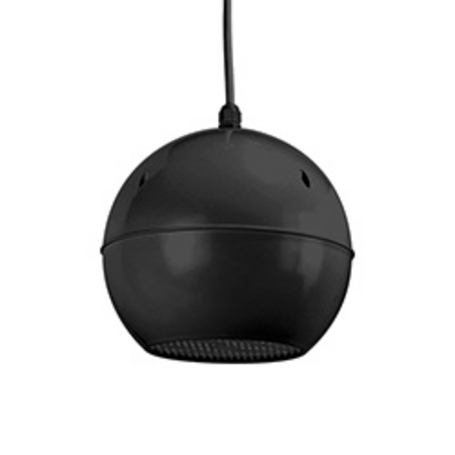
Spherical Speakers
For rooms with high ceilings, such as halls, production facilities, or home improvement stores.
Wide and uniform sound dispersion; depending on the design, 360° omnidirectional sound coverage is also possible.
The round shape minimizes interference.
Flexible height adjustment thanks to the adjustable pendulum length.

PA Sound Column
They are often used in churches and other places of worship, schools, universities, and training centers, as well as at lectures and panel discussions. Weather-resistant models are also among the most popular outdoor speakers for weddings, outdoor art installations, parks, and other settings that require open-air sound reinforcement.
A dynamic and full-range sound; precise sound dispersion and optimal speech intelligibility at every listening position.
Sound columns are similar to line arrays—they feature multiple vertically arranged drivers but are shaped like a single, narrow enclosure.
Retrofit installation is possible with minimal effort.

PA Compression Drive Speakers
Applications: In open or semi-open areas such as industrial buildings, exhibition halls, parking garages, outdoor swimming pools, sports fields and facilities, amusement parks, campgrounds, indoor riding arenas, stadiums, adventure playgrounds, as well as train stations and airports—in short, anywhere where speech must be heard loud and clear over long distances.
Known for their volume, stability, and excellent speech intelligibility; so-called “music horns” with a 2-way system offer very good music playback quality compared to conventional pressure-chamber speakers.
Distinctive horn shape.
Retrofit installation is possible with minimal effort.
Current Best Sellers
Passive Speakers: 4 Reasons to Choose Them
In active speakers, the PA amplifier is integrated directly with the corresponding power amplifier, ensuring perfect matching with the speaker. Nevertheless, there are good reasons to choose passive speakers:
- Cost-effectiveness: Passive speakers are generally less expensive because they require fewer materials. For many of our customers, high cost-effectiveness is one of the most important requirements.
- Simple 100-volt sound reinforcement: Passive speakers allow for straightforward installation with thin cables and eliminate the need to worry about impedances or additional outlets for active speakers. The technology is simple and efficient.
- Centralized Control: Managing passive speakers via a public address amplifier offers convenience and security. The sound system’s control center can be positioned flexibly, preventing unauthorized tampering with individual speakers.
Robust PA amplifiers are already in use in many existing systems. Passive speakers allow for a cost-effective expansion or upgrade of the installation, while the existing amplifier can continue to be used.

