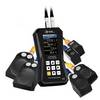
Stationary ultrasonic flow meter with different process connection possibilities / measuring accuracy of 1 % / pipe diameter from 25 mm to 1,200 mm / measuring flow rate and flow rate A stationary ultrasonic flow meter is a device for continuous monitoring of the flow rate of liquids in pipelines. One of the advantages of the measuring principle is that the sensors of stationary ultrasonic flow meters can be easily mounted on the outside of the pipe. For installation, the pipes do not need to be cut or drilled. This allows the measurement system to be installed without draining the pipes. Due to the contactless measurement principle of stationary ultrasonic flow meters, they can also be used in areas with high hygiene requirements, for example in the food industry. Depending on the conditions on site, our stationary flow meter can measure either with the reflection method or with the direct method. For the reflection measurement, which is also referred to as the V method, both sensors are mounted side by side on the same side of the pipe parallel to the flow direction. One of the sensors emits ultrasonic waves, the other sensor receives the waves reflected from the opposite side of the pipe. In contrast, for direct measurement, which is also called the Z method, the sensors are mounted on opposite sides of the pipe. Our stationary ultrasonic flow meter offers many settings and query options in the device menu. All necessary settings can be made directly at the installation point via keyboard inputs on the device. The membrane keypad also has a numeric keypad for quick entry of numerical values. After connecting the device, the data of the measuring point such as diameter, thickness and material of the pipe must first be recorded in menu M10 "Pipe settings" so that the measured values can be converted correctly. In menu M14 "INSTL Spacing", the mounting distance calculated for the captured pipe can then be read off for the sensors. After installing the sensors, a different menu can be used to determine whether the strength and quality of the signals are sufficient for reliable measurements. If not, the arrangement of the sensors can be adjusted or, if necessary, a different measuring point can be selected. As a stationary ultrasonic flow meter, the PCE-TDS 75 has various output options for transferring the measured data to other devices. Other devices can be controlled via the relay output and the analogueue output with 4 - 20 mA. The pulse output (OCT) can be used to output pulses for specified quantities, for example, to remote counters for consumption or throughput monitoring. The measured values can also be transmitted directly via the RS 232 or the RS 485 output. Our stationary ultrasonic flow meter can also be directly integrated into process controls via these interfaces. The PCE-TDS 75 can monitor fixed limits for minimum and maximum flow as a stationary ultrasonic flow meter. If the minimum is exceeded or if the maximum is exceeded, an alarm can then be triggered either via the relay or the pulse output. The continuously recorded flow rates are stored in the device. The M60 "Date Totalizer" menu allows you to view flow rates per year for the last 6 years, monthly for the last 12 months, and daily totals for the last 31 days. Here the PCE-TDS 75 as a stationary ultrasonic flow meter in the short characteristic:
This text is machine translated.