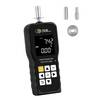
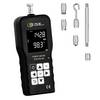
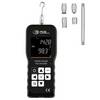
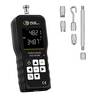
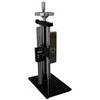
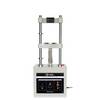
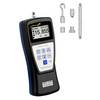
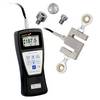
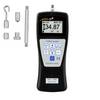
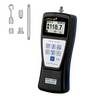
Force gauge / Penetrometer PCE-PTR 200N Penetrometer with integrated force cell / USB interface / evaluation software / measuring range up to 200 N / blind holes for mounting on the rear side / overload protection / measuring in N, kg, lb Penetrometer PCE-PTR 200N is a practical hand-held measuring device for the control of the tire degree of different fruit varieties. Unlike an analogue Penetrometer, this digital meter offers higher accuracy. The Penetrometer gives you valuable information about the optimum harvest time. In addition, quality can also be monitored during storage, transport and distribution. The Penetrometer has an internal measuring cell and is controlled by a microprocessor. This microprocessor enables a fast and accurate reading. The device is equipped with a mounting device for a test stand and can be mounted on it if one is available. This minimizes errors by the user and allows series measurements. The Penetrometer is operated via an internal battery that can be charged via a 240 V mains plug. The display can be rotated by 180°, was this facilitates the reading during the measurement. The software and data cable are used to transfer the measured values from the Penetrometer to a computer. Measurements can be made in the units N, kg and lb. A special plus of the PPCE-PTR 200N Penetrometer is the large measuring range with simultaneously high resolution and accuracy. Normally, a measurement of all occurring crops is only possible if three conventional penetrometers are available. This is the only way to accurately measure grades and diameters according to DIN. By using the Penetrometer, no further devices are necessary, as the three measuring adapters are included in the delivery. They can be screwed up and removed comfortably. Info Fruit strength / maturity If you talk about the development in fruit, you have to distinguish between physiological maturity and maturity for distribution. Physiological maturity is achieved only in the tree and it corresponds to the earliest harvest time for the distribution of these fruit varieties. The maturity for distribution is only achieved later and shows the best time for consumption (when the color, taste and strength are ideal for the end user). The climate-dependant fruits later reach maturity for distribution because they mature further after harvest. During maturity, an intensive internal change in the fruit is observed. This change is reflected in its color, shape and strength. It is necessary to obtain objective values with which you can follow the development of maturity. You will be able to identify the right measures for the best harvest time and the following trends (e.g. for determining the quality of fruit, the value for market distribution or for the end user), especially for climate-dependant fruit. Measuring the strength or toughness in fruit with the Penetrometer gives you information about the degree of maturity, so it is the most commonly used method of control. However, there are other methods that are used, for example, by the refractometer. The refractometers use the colorimetric method or they measure the content of soluble solids in fruit (this method allows you to determine the total sugar content). The strength and toughness measured with the Penetrometer will decrease with the maturity, but we must expect that the strength of a fruit variety can change under general conditions (the fruit variety or the growing zone) or under specific conditions (size, temperature, etc.). The strength of the fruit becomes lower the higher it is and the higher the temperature. Important information about the Penetrometer The Penetrometer PCE-PTR offers on its display the strength in grams, which is practiced on the fruit. In order to obtain the force applied in kg/cm², it is necessary to know the diameter of the selected penetration tip. For example, for a specific value of 4,320 g measured with the Penetrometer, you must calculate the actual force exerted depending on the tip of the penetration. This force corresponds to the value in kg divided by the corresponding surface of the penetration tip: Actual diameter of the penetration tip (mm): 6, 8, 11.3 Actual surface of the penetration tip (cm²): 0.28, 0.5, 1 force exerted (kg/cm²): 15.43, 8.64, 4.32 as opposed to the analogueue Penetrometer, this digital Penetrometer offers higher accuracy and resolution during measurement. Also the possibility to select the penetration tip (with three different diameters) for the Penetrometer saves you the purchase of several analogueue Penetrometers. Each of the analogue devices has only a specific area and a specific penetration point for a specific fruit variety, so you need a device for each fruit variety. The digital Penetrometer allows you to make different measurements with the same device. All you need to do is change the probe tip. Calibration The quality management standard DIN EN ISO 9001 requires a test equipment management with regular inspection of the test equipment included. However, there are no specifications for the type of calibration, the certification from the calibration laboratory and the scope of the calibration service. DAkkS calibrations meet the requirements unconditionally. For cost reasons, however, an ISO calibration is often performed on a Penetrometer. PCE Instruments offers an ISO calibration for the Penetrometer, so that you can always trust the compliance with the values specified in the technical data and look forward to the next ISO audit for the Penetrometer.
This text is machine translated.