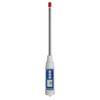
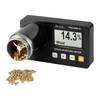
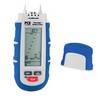
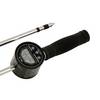
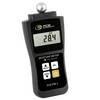
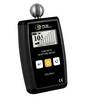
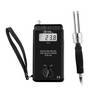
Soil moisture measuring device PCE-SMM 1 Measuring device for determining the moisture in the ground / with 250 mm probe / Measuring range up to 50% / waterproof How large the water content is in the ground plays an important role in many topics from agriculture, horticulture and environmental protection. Because the moisture of the soil allows conclusions to be drawn on behavior, fertility and water storage capacity. PCE Instruments soil moisture meter with a 250 millimeter probe has been specially developed to quickly, easily and accurately determine soil moisture content. The user-friendly soil moisture meter reliably shows the water content in soils in the range of 0 to 50 percent with a resolution of 0.1 percent. The application of the soil moisture meter is simple and effective. After the sensor is attached to the housing with a two-pole moisture electrode, the probe can be attached by screwing the ring tight. When the protective cap of the sensor head is removed, the soil moisture meter is ready for use. To determine the amount of water in the soil, the soil moisture meter probe should be placed at least ten centimeters deep in the soil. The results of the measurement are then displayed quickly and easily on the large LC display of the soil moisture meter. The manufacturer has equipped the soil moisture meter with a practical data record function, which stores the minimum and maximum values of a measurement. The compact dimensions and the battery operation enable the mobile use of the soil moisture meter while the stable and waterproof plastic housing protects the internal components even under rough conditions of use. To ensure that the battery-operated soil moisture meter is always ready for use, it indicates early on when a battery change is necessary. The soil moisture meter can be used in the temperature range between 0 and 50 degrees Celsius and with a humidity of up to 80 percent. The glass prism of the digital Brix refractometer, which is integrated in the stainless steel recess, can be cleaned quickly and easily before and after the measurement and is closed with a prism cover made of plastic. The manufacturer has designed the Brix refractometer to protect the glass prism from damage. The comfortable three-button operation guarantees a user-friendly operation. In order to conserve the battery of the meter, the manufacturer has equipped the Brix digital refractometer with an automatic shut-off function. When not in use, the Brix refractometer switches off automatically after one minute. A few drops of distiled water are sufficient to calibrate the Brix refractometer yourself at the push of a button, if necessary. Application areas The soil moisture meter guarantees highest reliability and precision. Therefore, the soil moisture meter is an ideal companion for all those who need to determine the properties of soils, for example to determine fertility or to control irrigation activities. The soil moisture meter can be used to quickly and easily determine the water content in soils. The soil moisture meter is therefore ideal for agriculture, horticulture and environmental protection for reliable immediate analyzes, it is versatile and easy to use. The waterproof case makes it easy to clean and use in any weather situation. Thanks to the handy and robust design and battery operation, the soil moisture meter can be used anytime and anywhere. Its simple operation makes the soil moisture meter indispensable for soil testing and is also suitable for inexperienced users. Soil moisture is a completely saturated soil with water when all pores in the soil are filled with water. Due to gravity, some of the water seeps into deeper soil layers. This vertically moving water is also known as seepage water and ultimately becomes groundwater. Soil moisture or the water bound to the surface by surface tension and capillary forces is not groundwater and is therefore also referred to as adhesion water. The soil moisture is divided into five humidity classes (wet, moist, fresh, dry, dürr). Important factors that determine the absorption capacity or storage capacity of water in the surface-near layers are pore size and the density of the soil, as it defines the water holding capacity.
This text is machine translated.