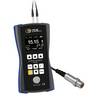
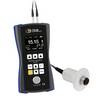
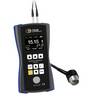
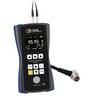
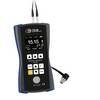
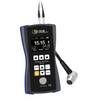
The ultrasonic echo-echo material thickness meter from PCE Instruments is suitable for measuring the wall thickness of homogeneous materials such as metals, plastics, glasses or resins by means of ultrasound in a measurement range of 0.65 … 600 mm. With a maximum resolution of 0.001 mm, even very small differences of wall thickness can be measured. For an exact measurement, the correct sound speed of the material to be measured must be set in the ultrasonic echo material thickness measuring device beforehand. With the PCE-TG 300-NO5 material thickness meter, the sound speed can be varied in steps of 1 m/s and a multi-point calibration is also possible. If the sound speed of the material is unknown, this can also be determined with the Echo Echo-Echo material thickness meter. If you know the thickness of the workpiece, you must enter it in the thickness meter. Ultrasonic echo Material thickness meter PCE-TG 300-NO5 Application 1.After placing the ultrasound sensor on the workpiece, the sound velocity of the material is displayed directly. The measured values are shown on a large LCD color display whereby a simple navigation via the quick-selection keys is possible. Measured values can be stored in the internal memory of the Echo-Echo wall thickness meter. This data can be evaluated either with the optionally available PC software or directly with a printer via Bluetooth. The functionality of the Echo-Echo wall thickness meter is extended via optionally available probes. Probes with 2.5 MHz; 5 MHz and 7 MHz and different diameters are available, so in addition to homogeneous standard materials, both strongly absorbing materials such as cast iron or plastic as well as thin-walled components can be measured.Measurement principle Ultrasonic Material thickness measurementThe human ear is able to detect sound frequencies of up to a maximum of 16 kHz, frequencies above this limit are not audible to humans and are referred to as ultrasound. This ultrasonic is used in industry in various areas such as welding, cleaning, non-destructive error testing (NDT) or also in material thickness measurement. Depending on the material, ultrasound is absorbed, reflected, scattered or transmitted. Ultrasonic echo Material thickness meter PCE-TG 300-NO5 Application 1.The measurement of material thickness by means of ultrasound is particularly suitable for all sound-conducting materials with homogeneous structure, in which very few scattering and reflection effects occur. Ideal, for example, are metallic materials such as steel, since the microstructure within the material conducts ultrasonic waves very well, thus producing high penetration depths and clear reflection echoes at the interface.The essential parameters in relation to the material are the sound speed and the sound attenuation. A distinction is made between sound absorption and sound dispersion in terms of sound attenuation. The sound absorption is achieved by converting the sound energy into other forms of energy such as, for example Causes heat. This reduces the strength of the useful signal, which results in shorter runtimes in the material when measuring the material thickness. Since the absorption depends on the frequency of the test head, the absorption can be attenuated, for example, by reducing the test frequency, which allows higher penetration depths. The sound weakening is caused by scattering effects at grain boundaries of the material structure. In this case too, the sound dispersion is increased by increasing the test frequency, even disproportionately compared to the absorption. When measuring the thickness of materials which are highly sensitive to sound, such as plastic or cast, some of the results can be improved by reducing the test frequency.The wave impedance or sound absorption and the sound velocity of different materials are used in ultrasonic material thickness measurement. The larger the differences in the impedance of the wave or acoustic resistance between adjacent materials, the clearer the ultrasound reflections can be determined. Air, for example, has a highly attenuating property in terms of ultrasound, so that strong reflection echoes occur at the interfaces between metals and air. This effect is used in the material thickness measurement to determine wall thicknesses. At the same time, this effect also ensures that coupling gel must be applied between the probe and the workpiece in order to bridge the air gap, which would prevent the transmission of the ultrasound from the probe to the workpiece without the application of coupling gel.Ultrasonic echo echo material thickness measurementMultiple echoes are evaluated in the ultrasound echo-echo material thickness measurement. This method for measuring the thickness of the material is particularly suitable for coated work pieces. If the ultrasonic sensor is placed on the coated workpiece, the coating is also calculated into the material thickness during a pulse echo measurement. This results in an error which is due to the different sound speeds of the coating material and base material. In the case of a steel piece coated with plastic, there are differences between the sound speeds of 3000 … 4000 m/s. If the sound velocity in the measuring instrument is set to steel, the coating would be measured at an incorrect sound velocity WAS will result in an erroneous result. In addition, the material thickness measurement is usually not the goal of measuring the thickness of a coating – for this purpose the thickness of the layer thickness measuring instruments is used, but the material thickness of the supporting material. The echo-echo function of the ultrasound thickness meter removes the thickness of the coating from the total material thickness. The ultrasound Echo-Echo material thickness meter can be used to measure the thickness of a coated workpiece without the coating thickness being included in the overall result.Ultrasonic sensors for material thickness measurementThe material structure of the material to be tested plays an important role in the material thickness measurement with regard to the sensor selection. As already described, the more homogeneous the material structure, the better the material thickness measurement works. Metal lattice structures are Ideal since the ultrasonic waves are passed through the material without large stray losses. In case of cast materials such as Cast iron is generally much larger due to the losses of graphite. This increases the energy losses of the ultrasound waves, which reduces the penetration depths. In case of very inhomogeneous materials, such as GFP or CFK is the measurement of wall thickness with a material thickness measuring device very difficult or often not possible.In order to solve this problem, the ultrasonic echo material thickness meter from PCE Instruments offers the option of selecting different sensors. The basic rule is, the more inhomogeneous the material, the deeper the ultrasound probe frequency should be. The thinner the material thickness and the more accurate the measurement is to be, the higher the probe frequency should be selected. For example, the 7 MHz ultrasound sensor would be suitable for thin-walled workpieces. For castings and plastics, 2.5 MHz should be selected. The ultrasound material thickness measuring device is supplied with a 5 MHz E-E sensor as standard. At 5 MHz, you can do justice to a relatively large number of applications, as soon as it becomes more demanding in a special area as described above, a probe change makes sense. The E-E function also enables the measurement of wall thicknesses through coatings. The other probes do not have this function.The ultrasound Echo echo material thickness meter is also suitable for high temperature applications. For applications with high surface temperatures up to 300 °C a high-temperature sensor with 5 MHz can be used. Please note that special coupling gel is required to withstand the corresponding temperatures. It should also be noted that sound speeds are temperature-dependent. At higher temperatures, it should be checked for greater accuracy how large the possible variations in the sound speed due to temperature changes are. In steel the sound speed is reduced by approx. 1% with a temperature increase by approx. 50°C. If the surface is 300°C hot, measurement deviations of a few tenths of a millimeter can occur if a sound velocity is entered in the material thickness measuring device, which is actually only valid for temperatures of approx. 20°C for the corresponding material.
This text is machine translated.