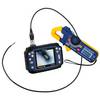
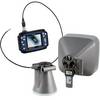
The video stroboscope PCE-VE 200 is an inspection camera for non-destructive measurement. This makes the video borescope the ideal instrument for diagnostics in hard to reach places. Mechanical engineering, sanitary and heating engineering, and the entire construction and construction sector are among the main areas of application of the video borescope. The video endoscope is also suitable for use in the automotive industry. Due to the fact that it has a camera tube of one meter long, there is the possibility to use the video endoscope in such a way that in many cases a dismantling of machines or motors is not necessary. This means time and money saving by turning the phone around. The camera head of the video borescope has bright LEDs that can be controlled and adjusted by the user on the device. The LEDs have different brightness levels so that an optimum illumination at the point of interest is possible. Therefore, there may not be overexposure, which would cause the image displayed on the screen to no longer be visible because the camera of the video borescope is dazzled. In addition to the lighting, there is also the function of a digital zoom for the current image section. The 2-fold, 3-fold or 4-fold magnification level is available here. The recorded images and videos are automatically saved on the micro SD card. This means that they can read and document the images from the video borescope later on. Digital-Mini-Ampere meter PCE-DC3 DCA Zero-point function / AC / DC current measurement up to 80 A / automatic range selection / jaw opening: 18 mm This clamp meter is designed for indirect recording of high-resolution AC/DC currents. A contact-less voltage tester function and a torch for illuminating the measurement point are also integrated into this clamp-on ammeter. The small dimensions of these ampere pliers allow you to use them in difficult to reach areas. The large illuminated display of these measuring instruments ensures a very good readability even at dark places such as in switch cabinets and cable shafts. The non-contact voltage tester function not only helps you detect dangerous voltage potentials, but also gives you an exact tool for determining the position of cable breaking in the cable drum, extension cables and device connection lines.
This text is machine translated.