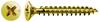
The Force Attack Cross Head Z is a further development of the simple cross-force attack by the company Philips SCREW COMPANY. The difference is that the four edges of the screwdriver blade do not taper toward the tip. This increases the lateral hold for the bit and reduces the cam-out effect. This is the result of conventional cross-head power attacks by rejuvenation, because the torque of the cordless screwdriver pushes the screwdriver bit upwards.
The countersunk head (or flat head) milled itself with its polygons bottom ("pockets") a recess in the wood and therefore can be recessed without additional lowering of the screw hole. The countersunk head locks flush with the surface.
In contrast to the partial thread, the full thread extends over the entire length of the screw. The more threads a screw has, the greater the tensile and compressive forces that can be deflected from screw to wood via it. Our threaded screws are used mainly for high-strength wood joints.
The term 4CUT stands for the square shape of the screw tip. These edges supplant the wooden fibers during insertion and creates space for the core diameter of the screw. This reduces the spread pressure exerted by the Kern in the wood and prevents the wood from springing up close to the edges. The necessary torque of the cordless screwdriver is also reduced, because the Kern of the screw does not have to "squeeze" itself into the wood.
Unlike conventional galvanized screws, the YELLOX chrome (VI)-free and therefore much more compatible with nature and humans. YelLOX screws are more resistant to corrosion with the same thickness of the surface layer. Nevertheless, their use is restricted to indoors. As the name suggests, YelLOX coated screws have a yellow appearance.