What is Virtual Reality and how does VR work?
Updated: 28.03.2021 | Reading time: 8 minutes
This text is machine translated.
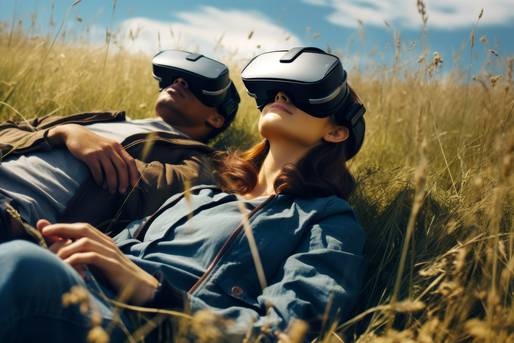
With virtual reality (VR), you experience fictitious environments as virtual reality, just as if you were there yourself. The medium transports the user to any location, which can appear realistic or correspond to a fantasy world. The view through VR glasses fills almost the entire field of vision. Right, left, up and down: you are always looking at the artificial world created by the computer. The goggles dynamically adjust the image and the sound also moves around the room.
Virtual reality is used in numerous commercial and private areas as well as in the education sector. The spectrum ranges from design and industrial applications, visualizations in the field of architecture, support for repair work and virtual space missions to driving and flight simulators and computer games.
Today's virtual reality has little in common with the 3D grid models of the early days. The graphics performance of current graphics chips is a million times stronger, sensors are more precise and latency times are shorter, which, in combination with modern VR software, ensures a perception that is similar to real life.
Virtual reality is based on our stereoscopic spatial vision. The software generates two images that show a scene from slightly different angles. VR goggles, also known as a head-mounted display (HMD), transmit the image information to you as the wearer. Displays directly in front of the head play the image generated for the respective side to the right and left eye. Lenses ensure that the display content, which is only a few centimeters away, is correctly focused.
The brain merges both images into a three-dimensional view with a spatial depth effect. Due to the short viewing distance, the eye no longer recognizes the boundaries of the displays. You look into a seemingly limitless virtual 3D world.
Head tracking creates the credible impression of actually being in the computer-generated reality. The VR glasses transmit their physical presence into the virtual space. The software immediately adapts the content on the displays accordingly. If you move your head or your whole body, your movements are transferred to virtual reality. You can move, look around and interact freely in the three-dimensional environment.
Thanks to a harmonious synchronization of head movement and VR perspective, the brain perceives the three-dimensional graphics as real. At the same time, you no longer notice the necessary technical aids after a short period of familiarization. The visual simulation is enhanced by appealing to other senses, such as spatial sound effects via the headphones of the VR goggles.
The possible applications of VR in the private and commercial sectors as well as in research and teaching are extremely diverse.
Informing, experimenting, experiencing, visualizing, presenting, training or entertaining:
Wherever a classic 2D representation does not provide sufficiently detailed insights, virtual reality can improve the transmission of information, perception and memorization in the brain. Immersion and interaction create a realistic level of perception in VR applications that goes beyond the conventional visual impression.
Many people think of VR primarily in terms of games. However, as a technology, it helps companies such as kitchen studios or interior designers to show customized room solutions true to the original. In the automotive industry, virtual reality is used for parts development and maintenance optimization. Medical staff train care situations digitally with VR support.
You can easily try out how practical VR is for you with a smartphone mount. There is a wide range of suitable VR apps for Android and iOS.
With which devices is virtual reality possible?
You need the right equipment to use virtual reality. This consists of hardware in the minimum form of VR glasses or a VR headset and suitable software. VR glasses can be divided into device classes: mechanical smartphone holders (cardboards), smartphone holders with built-in electronics and VR headsets with their own display.
Cardboards for affordable VR entry
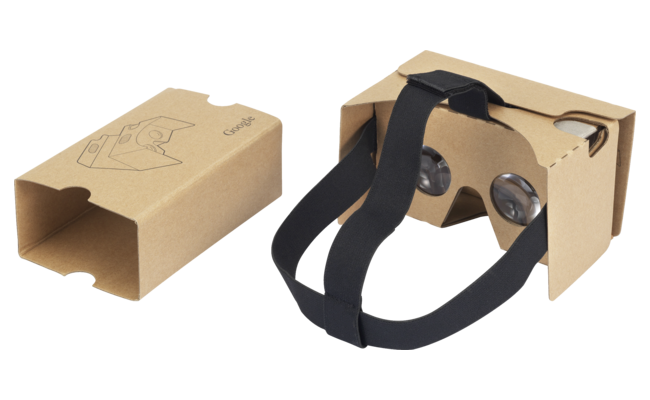
Cardboards are purely mechanical VR glasses without electronics. They consist of a holding frame for inserting the smartphone and are the cheapest way to get started with virtual reality.
The frame with magnifying lenses holds the front of the cell phone at the correct distance from the eyes. An app on the cell phone displays the image information for each eye individually. Movements are detected by the gyro sensors in the cell phone and evaluated by the app. In addition to universal models, there are cardboards for specific smartphone types. The simplest models lack a focus adjustment option, while better cardboards work with adjustable lenses and can focus on the cell phone display.
Smartphone holders with electronics
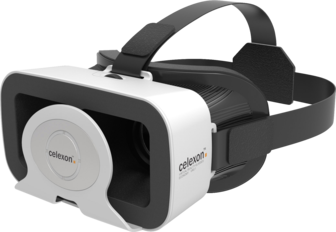
In addition to phone recording and a lens system, better smartphone glasses also have electronic components for head tracking on board. The sensors detect head rotation and head tilt for smooth image transitions and a more immersive feeling.
Some systems come with their own displays. The smartphone is connected to the VR goggles via a connection cable and serves purely as an image generator and control console for the VR application.
Virtual-Reality-Headsets
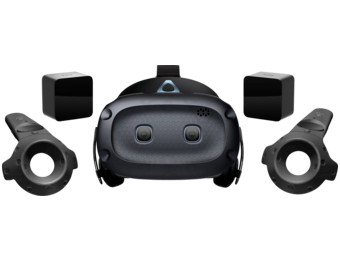
VR headsets such as the Oculus Rift, HTC Vive or Sony Playstation VR deliver the most impressive VR experience. They are capable of complete head and hand tracking, including position detection in space. The devices therefore know where the user is currently located and influence image generation and the VR experience. Depending on the model, the VR systems from Oculus, for example, work independently of the smartphone and computer apart from the configuration or, like Sony's virtual reality glasses, in conjunction with a games console.
Important selection criteria for virtual reality headsets are the size of the built-in displays, maximum brightness and contrast, refresh rate and field of view. It is advantageous to be able to adjust the eye distance to suit the wearer.
VR, AR, AV and MR - all these acronyms are often heard in the same breath as virtual reality. They all stand for exciting 3D media for everyday life, working life and new business models. What are the differences between the technologies and what do they have in common?
The term mixed reality is often used in connection with virtual reality and augmented reality. It stands for the area between the unadulterated real world and the purely virtual world, for example augmented reality and augmented virtuality.
In common parlance, mixed reality is often used synonymously with augmented reality.
Whether in product development, quality assurance, maintenance, trade or the service industry, virtual reality technology is of great importance for companies.
Medicine
Trainee surgeons can safely practice complex procedures on virtual patients without endangering the patient's life and limb.
Industry
From planning and project planning to the first product test and presentations, the production of expensive pre-series samples can be completely dispensed with.
Psychology
With the help of virtual reality, individual scenarios can be created to actively support patients in the treatment of autism, phobias or post-traumatic stress disorder.
Education
Visualized teaching content is grasped more quickly and is more memorable if, for example, the student was “live” during the flight to the moon or other important historical events.
Craft
Manual skills, such as the use of a paint spray gun, can be learned quickly and easily without wasting consumables or damaging expensive workpieces.
Architecture
Architects, site managers or even customers can take a virtual tour of a new building in advance during the planning stage. Planning errors are thus identified at an early stage and can be rectified before the foundation stone is laid.
Tourism
Enjoy a virtual view from your booked hotel room before you start your vacation or take a look at the sights of your vacation destination in advance. This gives you the feeling of having been there before when traveling to a new vacation destination.
Film and television
Just like in 3D cinemas, we may soon be watching 3D films with a 360° all-round view using VR glasses. This will make the movie experience at home even more exciting and is almost like going to a 3D cinema!
When it comes to learning and acquiring knowledge at school, virtual realities are of great importance for illustrating complex learning content. In the classroom, the new technology enables better visualization of the subject matter and learning through experience.
Digital worlds and augmented reality as interactive media are particularly useful for imparting knowledge in STEM subjects and the fields of history, geography and natural sciences.
-
Chemical compounds, enzyme processes in the body or the blood circulation are more vivid with VR than in textbooks or diagrams.
-
Teachers bring historical places into the classroom with virtual reality, visualize abstract concepts or make the structure of complex objects visible.
-
Interactive access to places and resources that would otherwise not be available in the classroom is another advantage of VR as a tool in an educational context.
The potential of experiential knowledge acquisition lies in the interaction, which increases understanding and receptivity. With VR, the subject matter reaches the brain via several sensory channels simultaneously. This increases the likelihood of information being well memorized.
You can find out more about this in our guide to virtual reality in the classroom.