Virtual reality for beginners » Get started with smartphone glasses or VR headset
Updated: 27.03.2021 | Reading time: 8 minutes
This text is machine translated.
Virtual reality is a fascinating topic that is not only of interest to technology fans with a well-filled wallet. The artificially created 3D worlds can be easily discovered without much effort and on a small budget. An existing smartphone and inexpensive smartphone glasses are all you need.
Virtual reality (VR) adds VR content to the real world with the help of virtual reality glasses. At the heart of VR applications is the head-mounted display (HMD). It is worn like goggles or a helmet with a visor and shows computer-generated images on a display directly in front of the user's eyes. An existing smartphone with an appropriate holder can also take over the task of the screen placed close to the eye. This keeps the costs and technical effort for VR beginners low, for example for VR games or homeschooling.
Virtual reality can be used for gaming and simulations, training and marketing purposes, planning and development, in the education and communication sector, for cinema entertainment and industrial applications, for example in logistics and maintenance.
Head-mounted displays are available in different versions, depending on whether they are primarily used for digitizing the world of work or entertainment:
| See-through video glasses (see-through HMDs) are modern work aids that use augmented reality to superimpose helpful data or images into reality for certain tasks. This allows a maintenance technician, for example, to see which components they need to check. |
| Monocular video glasses (look-around HMDs) provide information via augmented reality for one eye, for example for navigation or training on machines. They give the second eye a clear view of the real environment. Like see-through video goggles, monocular HMDs can also provide excellent assistance with complex tasks. |
| Closed video glasses (non-see-through HMDs) cover the user's field of vision. They completely block out the real environment and only present digital content in its place. By projecting onto both eyes, visual perception is limited to the VR world in which the user is immersed. Immersion creates a feeling of being right in the middle of things. Clever: closed video glasses usually feature video see-through. A camera digitizes the image of the real environment and feeds it into the VR world. |
To create the perfect illusion, closed video glasses use two displays, one for each eye. Optical lenses in the goggles ensure a large field of vision. The best-known models include Oculus Rift, Oculus Quest, HTC Vive, Valve Index, HP Reverb G2 and Playstation VR. Smartphone glasses show the virtual content individually for each eye on the display of the cell phone. In better models, lenses ensure a comfortable eye experience with a large field of vision.
An important function of VR glasses and VR headsets is motion tracking to detect your movements and head tracking to detect your line of vision and head tilt.
The tracking systems use either gyro sensors or, in the case of inside-out tracking, several cameras to detect the position and orientation of the user in space and measure changes in movement.
The position and movement data obtained controls the VR application and is translated into virtual space. VR headsets with eye tracking also recognize eye movements and can therefore determine which object you are currently focusing on.
Accurate tracking systems with low latency enable delay-free movements in 3D space. The more precise and faster motion tracking and head tracking work, the more fluidly the VR application responds.
Smartphones are equipped with powerful gyro sensors and accelerometers as standard. They can be used by VR apps alone or in conjunction with the smartphone camera for tracking. As a result, smartphone VR glasses usually do not require additional environmental sensors, which makes the systems affordable and attractive for beginners.
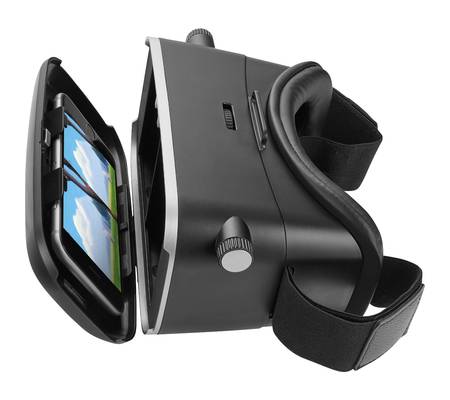
In their simplest form, virtual reality glasses for smartphones are a universal mechanical cell phone holder without electronics that holds the cell phone at the right distance in front of your eyes.
In addition to universal smartphone goggles in different price ranges, there are also versions specially designed for specific models or smartphone series. A custom-fit cut-out ensures wearing comfort and lenses tailored to the characteristics of the smartphone display enable a more intensive VR experience. Such smartphone headsets can also have their own motion sensors and speakers or in-ears.
The illustration shows a pair of universal smartphone glasses, with the main components shown as an example.
-
Housing: Holds smartphone and ensures correct distance
-
Phone recording: Phone must be held securely and reliably in position
-
Optical lenses: Partially adjustable to provide a sharp image for each eye.
-
Focus setting: This is used to focus images from the smartphone.
-
Lens adjustment: Adjustable distance between the two lenses.
-
Spectacle pads: Ensure a comfortable fit for the spectacles.
-
Carrying straps: Wide and adjustable for optimum carrying comfort.
Inexpensive cardboard holders for smartphones (cardboards) are suitable for trying out the virtual world. A more comfortable model that also offers more functions is recommended as a permanent solution.
The weight of the glasses with the smartphone inserted should not be neglected when worn for long periods. Wide and adjustable straps that distribute the weight are advantageous.
Smartphone VR glasses are available with a flip-up attachment or a slide-in compartment. In principle, both are possible, although with the flip-up attachment, cell phone controls such as the on/off switch or volume control may be activated unintentionally.
Look out for a focus setting when buying. Individually adjustable lenses allow you to adjust the focus for each eye as if you were wearing reading glasses, so you can see a sharp image despite the short viewing distance to the cell phone display.
After trying out an inexpensive version for a while, you can switch to a higher-quality model at any time. Thanks to the inexpensive entry-level models, no major investments have been made, making the decision to buy real VR glasses even easier!
Anyone who doesn't just want to watch, but wants to be fully active in the virtual world, can intervene in the action with a controller.
- Simple VR controllers for smartphone glasses are connected to the cell phone via Bluetooth, but are only supported by a few apps.
- Some special smartphone cases, such as the Samsung Gear VR, come with a matching controller.
- One or two precise hand controllers are standard with VR products from major providers such as HTC Vive, Oculus Rift, HP or PlayStation 4 / 5.
The controllers from HTC & Co. are equipped with a touchpad, trackpad, buttons and a mini-joystick, depending on the version. The more control options there are, the more varied your actions in the virtual world. However, an increase in control options also increases the learning curve.
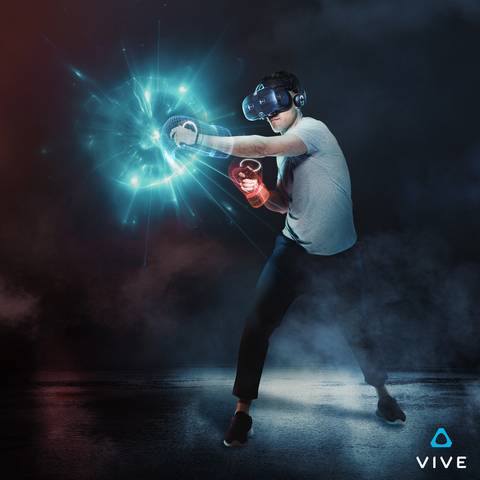
Some hand controllers recognize how hard you press. Touch controllers allow you to hold virtual objects in your hand and not just touch them.
Models with haptic feedback allow you to feel how they interact with the virtual world through vibrations or impulses.
Which virtual reality headset for beginners?
Away from smartphones, there are more and more virtual reality headsets with professional VR technology at affordable prices. Companies, demanding users and VR enthusiasts are benefiting from the growing variety of models. In addition to image quality, sound and tracking technology, the headsets differ in terms of head attachment, weight and compatible applications.
Celexon Professional
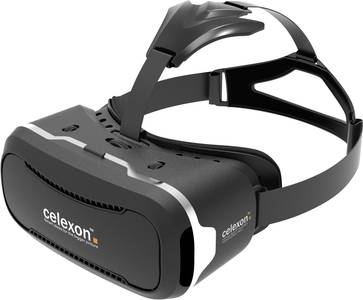
The manufacturer Celexon offers various models in the affordable price segment. The large field of view of 110° is ideal for the latest smartphone models. This model is also ideal for spectacle wearers.
Headmount Google 3D VR
The Headmount Google 3D VR virtual reality glasses show that getting into virtual reality doesn't have to be expensive if you have the right smartphone. Display sizes from 8.9 cm (3.5“) to 15.24 cm (6”) are compatible.
FOREVER Universal glasses
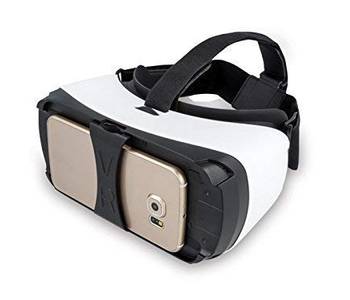
3D virtual reality glasses with Bluetooth connection for movies, games and videos. Suitable for Android and iOS smartphones with 4.5-5.5"” inch display size.
Renkforce RF-VR1
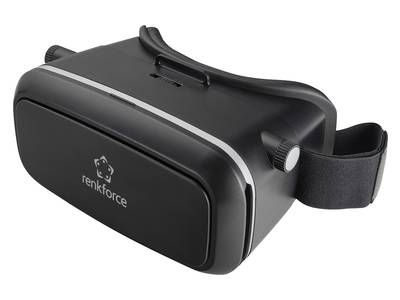
Suitable for smartphones with a diagonal of 8.89 cm (3.5“) to 15.24 cm (6”). Adjustable lenses (forwards/backwards, left/right) for pupil distance and image sharpness ideally adapt the image quality.
These models offer a good introduction to the world of VR. If you decide to go for a model in the higher price range, which of course also has significantly more functions, we are sure to have the right model for you!
Field of vision
When buying, pay attention to the size of the field of view, also known as FoV, which is specified in degrees. It indicates how much of the virtual environment your eyes can see and therefore how much VR you can see. The largest possible field of view increases immersion and creates an intense feeling of being right in the middle of things.
Audio
VR glasses with integrated headphones have speakers that sit on your ears or rest on top of you. Systems with 3D audio emit the sound in such a way that it is aligned with your movements.
Wireless VR
Smartphone glasses do not require a connection cable, which makes them easy and convenient to use. VR headsets often work with a cable connection to the computer. For Room Scale VR applications where you move freely around the room, make sure you have sufficiently long cables. A wireless adapter, available as an accessory, eliminates the need for a cable to the VR headset.
Even if you wear glasses, you can normally enjoy virtual reality to the full with VR headsets. For a better fit, remove the face cushion from the headset and attach a spacer for glasses.
You may even be able to do without optical glasses: Some VR headset manufacturers include additional lens sets for those who are slightly or severely short-sighted.
If you wear particularly delicate glasses or a model with a protruding design, contact lenses are a comfortable alternative.
With VR glasses for smartphones, there may not be enough space for an optical aid from an optician. A model with an adjustable focus is therefore particularly important for spectacle wearers, as you cannot wear normal glasses under every model.
The content of the 3D video is displayed on two monitors.