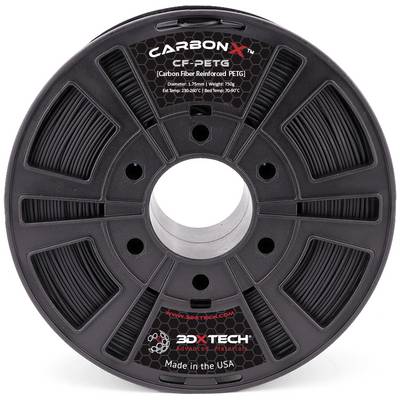
Superior chemical resistance to ABSAmorphous: Low and near isotropic shrinkageLow moisture absorption: 3x lower than ABS
Technical specifications
Product type
Filament
Filament material
PETG
Filament properties
chemical-resistant
odourless
Filament Ø
2.85 mm
Filament colour
Black
Printing temperature (min.)
230 °C
Max. printing temperature
260 °C
Weight
750 g
Content
1 pc(s)
Documents & Downloads
Security datasheet
Security datasheet 2632867 3D Xtech PTG2030750BK0 3DXSTAT Conductive ESD Filament PETG chemical-resistant, odourless 2.85 mm 750 g Black 1 pc(s)
Description
ESD PETG is an advanced ESD-safe connection designed for use in critical applications requiring ESD (ESD) protection. Manufactured using state-of-the-art multi-wall carbon nanotubes technology, state-of-the-art compounding technology and precision extrusion.
Chemical resistance Untensioned PETG drawbars have good resistance to diluted aqueous solutions of mineral acids, bases, salts and soaps as well as to aliphatic hydrocarbons, alcohols and a variety of oils. Halogenated hydrocarbons, short-chain ketones and aromatic hydrocarbons dissolve or sources the plastic.
Typical applications are Semi-con: Hard disk components, wafer handling, fixtures, housings and connectors Industrial: Conveying, measuring and recording applications
Target conductivity for 3DXSTAT ™ ESD PETG 10 ^ 7 to 10 ^ 9 ohms surface resistance on a 3DP sample using a concentric ring test method. Note: Internal studies have shown that elevated extruder temperatures can achieve higher conductivity. Similarly, lower extruder temperatures have led to lower conductivity. Each printer is set up differently and has different part geometry. Therefore, expect a certain test time to understand how this filament works in your specific printer/application. However, please do not exceed 270 °C to reduce the risk of polymer removal.
Surface conductivity depending on the extruder temperature The surface resistance of the printed ESD-safe part depends on the extruder temperature of the printer. For example, if your tests show that the part is too insulating, increasing the extruder temperature will result in improved conductivity. Therefore, the surface resistance can be adjusted by setting the extruder temperature up or down, depending on the measured value you get from your side.
This text is machine translated.
Features
Superior chemical resistance to ABS
Amorphous: Low and near isotropic shrinkage
Low moisture absorption: 3x lower than ABS
Very low odor when printing
Superior ductility compared to ABS
Wide processing range: 230 - 260 °C.
Uniform surface resistance
Improved retention of impact and elongation
Low particle load
Minimal contribution to output and ionic contamination
What kind of 3D Printer Filaments are you looking for?