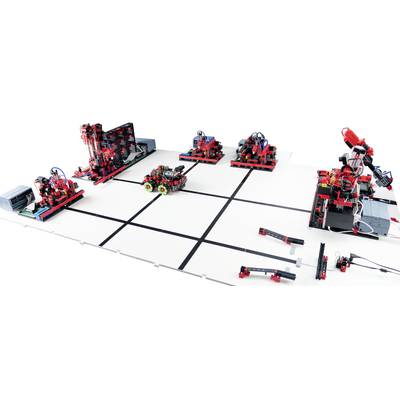
Efficiency, agility, and flexibility are essential when building current and future factories.
fischertechnik now introduces a training model of such a flexible and modular factory – the Agile production simulation. The factory consists of individual modules such as incoming and outgoing goods, high-bay warehouse, milling station, drilling station, quality assurance with AI. A driverless transport system transports workpieces flexibly between the individual stations and ensures a flexible production process that can be adapted to customer requirements. The factory can be expanded to include a kiln, other drilling or milling stations and additional driverless transport systems.
Each workpiece contains an NFC tag on which production data is written (color of the workpiece, time of delivery, time of import and removal, production steps performed, quality inspection carried out). The different colored workpieces (white, red, blue) go through different production processes and thus go through different stations in the factory and have different lead times.
The factory is controlled by a central controller (Raspberry Pi 4 Model B), which is networked with the controllers of the individual factory modules, PLC Siemens S7 1200 in the 24 V version. The central control communicates via the standard FTS interface VDA 5050 and controls the transport orders for the FTS. Message Queuing Telemetry Transport (MQTT) protocol is used for communication.
The factory is also connected to the fischertechnik cloud via a WLAN router, which contains an online shop for ordering workpieces by the customer. Dashboards are also available for job control, factory state visualization, and key metrics. To simulate remote maintenance, the images taken by the mobile camera in the factory are displayed in the dashboard so that the condition of the factory can be viewed remotely.
Physically, the base plates of individual modules of the factory are connected together to form a contiguous base plate using a tongue and groove principle. Additional modules can be added at the open ends and configured in the dashboard.
In addition to a detailed introduction to the handling of the factory, the didactic accompanying material offers extensive teaching material. Content is for example. The basics of industry 4.0, modular production, intelligent networking, human-technology organization, digital twin, Sensor data analysis in real time and much more.
This text is machine translated.