128MB Flash (64K reserved for recovery & EEPROM emulation)
USB host port
2 additional flash memory slots
3 CAN bus (1 with CAN FD)
2 I2S digital audio
1 S/PDIF digital audio
1 SDIO (4 bit) native SD
3 SPI, all with 16 words FIFO
3 I2C, all with 4 bytes FIFO
7 Serial, all with 4 bytes FIFO
32 general purpose DMA channels
31 PWM pins
40 digital pins, all interrrupt capable
14 analogue pins, 2 ADCs on the chip
Cryptographic acceleration
Random number generator
RTC for date/time
Programmable FlexIO
Pixel processing pipeline
Peripheric cross release
Ethernet PHY
MicroSD card slot
Power management on/off
Operating voltage 3.3 to 5V
1024 kB
Clock speed
600 MHz
Length
61 mm
Width
18 mm
Product type
Microcontroller
MC layout
32-bit
Documents & Downloads
User & Safety Instructions
User & Safety Instructions 2269230 PJRC Teensy41 Microcontroller Teensy 4.1
Description
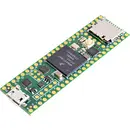
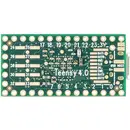
The new Teensy 4.1 features an ARM Cortex-M7 600 MHz processor, an NXP iMXRT1062 chip, four times the size of the Flash memory of Teensy 4.0, and two additional memory slots to expand memory. It has the same size and shape as the Teensy 3.6 (2.4 x 0.7 inch) and offers greater I/O capability, Ethernet PHY, SD card slot and USB host port. When operating under full load, the Teensy 4.1 requires approx. 100 mA current and provides support for dynamic clock scaling. Unlike conventional microcontrollers, where clock speed changes cause incorrect baud rates and other problems, the Teensy 4.1 hardware and software support for Teensyduino's Arduino timing functions are defined to allow dynamic speed changes without problems. Serial baud rates, audio streaming sampling rates and Arduino functions such as delay() and Millis() as well as Teensyduino extensions such as IntervalTimer and elapsedMillis work exactly even when the CPU speed is changed. The Teensy 4.1 also offers an option for switching off the power. By connecting a push button to the on/off pin, the 3.3 V power supply can be completely switched off by holding the button for five seconds and switched on again by briefly pressing a button. If a button cell is connected to VBAT, the RTC of Teensy 4.1 continues to keep an eye on the date and time even when the power is off. The ARM Cortex-M7 brings many powerful CPU functions to a real-time microcontroller platform. The Cortex-M7 is a dual superscaler processor, meaning the M7 can execute two commands per clock cycle at 600 MHz. The simultaneous execution of two commands depends of course on the compiler ordering commands and registers. Initial benchmarks have shown that Arduino-compiled C++ code tends to execute two instructions in about 40% to 50% of the time, while performing numerically intensive work with integers and pointers. The Cortex-M7 is the first ARM microcontroller to use the branch prediction. On M4, loops and other code that has a lot of branching need three clock cycles. With M7, after a loop has been executed several times, the branch prediction removes this overhead, so that the branch instruction can be executed in a single clock cycle. Tight Coupled Memory is a special feature that allows Cortex-M7 to quickly access the memory in a single cycle using a pair of 64-bit wide buses. The ITCM bus provides a 64-bit path for retrieving instructions. The DTCM bus is actually a pair of 32-bit paths that allow M7 to perform up to two separate memory accesses in the same cycle. These extremely fast buses are separated from the M7's AXI main bus, which accesses other memory and peripherals. 512 memory can be accessed as a tightly coupled memory. Teensyduino automatically assigns your Arduino sketch code to the ITCM and any non-allocated memory uses to the fast DTCM unless you add additional keywords to override the optimized default. Memory that is not accessed on the tightly coupled buses is optimized for DMA access by peripheral devices. Because most of M7 memory access is done on the two tightly coupled buses, high-performance DMA-based peripherals have excellent access to non-TCM memory for highly efficient I/O. The Teensy 4.1 Cortex-M7 processor includes a floating-point unit (FPU) that supports both 64-bit "double" and 32-bit "float". With the FPU from M4 to Teensy 3.5 & 3.6 and also the SAMD51 chips from Atmel, only 32-bit float is hardware accelerated. Any use of double, double functions such as log(), sin(), cos() means slow software-implemented mathematics. Teensy 4.1 performs all of these functions with FPU hardware.
This text is machine translated.
Scope of delivery
Microcontroller; Information card
Description
The new Teensy 4.1 features an ARM Cortex-M7 600 MHz processor, an NXP iMXRT1062 chip, four times the size of the Flash memory of Teensy 4.0, and two additional memory slots to expand memory. It has the same size and shape as the Teensy 3.6 (2.4 x 0.7 inch) and offers greater I/O capability, Ethernet PHY, SD card slot and USB host port. When operating under full load, the Teensy 4.1 requires approx. 100 mA current and provides support for dynamic clock scaling. Unlike conventional microcontrollers, where clock speed changes cause incorrect baud rates and other problems, the Teensy 4.1 hardware and software support for Teensyduino's Arduino timing functions are defined to allow dynamic speed changes without problems. Serial baud rates, audio streaming sampling rates and Arduino functions such as delay() and Millis() as well as Teensyduino extensions such as IntervalTimer and elapsedMillis work exactly even when the CPU speed is changed. The Teensy 4.1 also offers an option for switching off the power. By connecting a push button to the on/off pin, the 3.3 V power supply can be completely switched off by holding the button for five seconds and switched on again by briefly pressing a button. If a button cell is connected to VBAT, the RTC of Teensy 4.1 continues to keep an eye on the date and time even when the power is off. The ARM Cortex-M7 brings many powerful CPU functions to a real-time microcontroller platform. The Cortex-M7 is a dual superscaler processor, meaning the M7 can execute two commands per clock cycle at 600 MHz. The simultaneous execution of two commands depends of course on the compiler ordering commands and registers. Initial benchmarks have shown that Arduino-compiled C++ code tends to execute two instructions in about 40% to 50% of the time, while performing numerically intensive work with integers and pointers. The Cortex-M7 is the first ARM microcontroller to use the branch prediction. On M4, loops and other code that has a lot of branching need three clock cycles. With M7, after a loop has been executed several times, the branch prediction removes this overhead, so that the branch instruction can be executed in a single clock cycle. Tight Coupled Memory is a special feature that allows Cortex-M7 to quickly access the memory in a single cycle using a pair of 64-bit wide buses. The ITCM bus provides a 64-bit path for retrieving instructions. The DTCM bus is actually a pair of 32-bit paths that allow M7 to perform up to two separate memory accesses in the same cycle. These extremely fast buses are separated from the M7's AXI main bus, which accesses other memory and peripherals. 512 memory can be accessed as a tightly coupled memory. Teensyduino automatically assigns your Arduino sketch code to the ITCM and any non-allocated memory uses to the fast DTCM unless you add additional keywords to override the optimized default. Memory that is not accessed on the tightly coupled buses is optimized for DMA access by peripheral devices. Because most of M7 memory access is done on the two tightly coupled buses, high-performance DMA-based peripherals have excellent access to non-TCM memory for highly efficient I/O. The Teensy 4.1 Cortex-M7 processor includes a floating-point unit (FPU) that supports both 64-bit "double" and 32-bit "float". With the FPU from M4 to Teensy 3.5 & 3.6 and also the SAMD51 chips from Atmel, only 32-bit float is hardware accelerated. Any use of double, double functions such as log(), sin(), cos() means slow software-implemented mathematics. Teensy 4.1 performs all of these functions with FPU hardware.