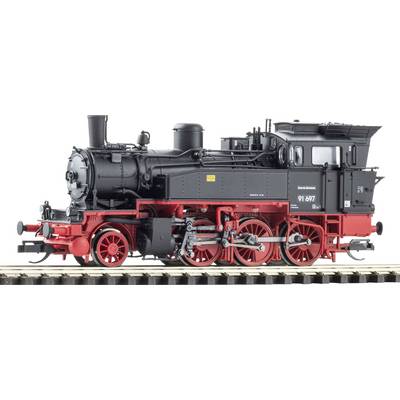
User & Safety Instructions 3765762 PIKO 47150 TT STEAM LOC. BR 91.3 DR III
Description
TT STEAM LOC. BR 91.3 DR III New feature 2026: The T 9.3 was a robust tender locomotive that was equally convincing in the passenger as well as freight train service. With a maximum speed of 65 km/h it was one of the most powerful machines of its time – and became one of the most built locomotives in Germany. From 1901 on the Prussian State Railways acquired over 2,000 copies of this proven type at the Königsberger Union Foundry. The regional railways in Alsace-Lorraine also took the T 9.3 and ordered a further 132 locomotives. In 1925, the Deutsche Reichsbahn took over the majority of the vehicles in their inventory and classified them as series 91. In the course of their long service life, numerous locomotives were sent abroad, among other things to the Czech Republic and Poland. After the Second World War, many specimens remained in Germany, where they performed their services reliably until the 1960s and 1970s. With its combination of strength, versatility and solid technology, the T 9.3 continues to represent the engineering art of the early steam locality – a real workhorse on the tracks that history has written.
TT STEAM LOC. BR 91.3 DR III New feature 2026: The T 9.3 was a robust tender locomotive that was equally convincing in the passenger as well as freight train service. With a maximum speed of 65 km/h it was one of the most powerful machines of its time – and became one of the most built locomotives in Germany. From 1901 on the Prussian State Railways acquired over 2,000 copies of this proven type at the Königsberger Union Foundry. The regional railways in Alsace-Lorraine also took the T 9.3 and ordered a further 132 locomotives. In 1925, the Deutsche Reichsbahn took over the majority of the vehicles in their inventory and classified them as series 91. In the course of their long service life, numerous locomotives were sent abroad, among other things to the Czech Republic and Poland. After the Second World War, many specimens remained in Germany, where they performed their services reliably until the 1960s and 1970s. With its combination of strength, versatility and solid technology, the T 9.3 continues to represent the engineering art of the early steam locality – a real workhorse on the tracks that history has written.