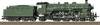
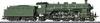
Steam locomotive Class S 3/6 "High-Haxige"
Magical – Attractive – Elegant
In spring 1907, Maffei received the contract to build a Pacific composite locomotive from the Royal Bavarian State Railways. Based on the Baden "IV f" created in the same house, Maffei developed the Bavarian S 3/6, which was soon to fascinate generations of railway enthusiasts by its timeless elegant appearance, especially characterized by the four-cylinder composite engine.
Steam locomotive type S 3/6 or series 18.4 The first machine left the factory in July 1908. Maffei delivered a further 16 machines of largely identical design in three series until 1911. In contrast to the first locomotives, 18 machines (series d and e, Maffei 1912/1913, company no. 3624-3641) Driving wheels with 2,000 mm diameter. As a result, the boiler of these machines was also higher. Just the 1912/13 "High-Haxien" S 3/6, which was placed in service, developed into a masterpiece of Bavarian express train locomotives. They proved to be outstanding cross-country skiers and were especially suited to fast trains. As soon as they did, they transported the D 57/58 between Munich and Würzburg (277 km in 3:20 h) and the D 79/80 between Munich and Nuremberg (199 km in 2:15 h) without stopping. Unfortunately, the First World War ended these outstanding achievements again a little later. At the DRG, the remaining machines with small wheels received numbers 18 401-434, 18 461-478 and 18 479-548, and the "high-haxes" the numbers 18 441-458. The latter remained true to their Bavarian homeland with few short-term exceptions. Although all the "high-haxians" survived the Second World War, the time of the Federal Railways hardly experienced a machine anymore, almost all of them were phased out in the first years after the war. The only exception was the 18 451, as it was available from February 1950 at the Lokomotiv-Experimental Station in Göttingen. There she completed a number of excellent rides, among which the cross-country skiing of 2 May 1951 is still a special place. The driving times of the newly introduced high-speed rail car Ft 56 were specified for the new double-deck train to be transported from Hamburg to Munich. In fact, the 18 451 was able to keep the Ft running time and sometimes even slightly undercut it. However, the most remarkable aspect of this trip was the 820 km long cross-country route, with only a 40-year-old locomotive and without a drop-out. In fact, upon arrival in Munich, the fire was so good that the 18 451 could have managed another 100 to 200 km. From April 1952, the testing institute was able to do without the locomotive and it was parked. Until 1958, she was worked up in the Ingolstadt AW as a model, returned to its original state and handed over to the German Museum in Munich as a gift, where she remains the only "high-haxite" to date as an honorary place.
Model: Express train steam locomotive of the Bavarian type S 3/6 with coal towing tender 2´2 T32.5. Royal Bavarian State Railways (K.Bay.Sts.B.). Sub-base series d, "high-axial" with 2,000 mm driving wheel diameter Operating number 3627. Operating condition circa 1912.
With digital decoder and a wide range of sound features. Regulated high-power drive with flywheel mass in the boiler. 3 Powered axles Locomotive and tender to a large extent made of metal. Filigree metal chassis with perforated frame. Free chassis view. Two-light head end signal changes dependent upon the direction of travel operated conventionally, can be switched digitally. Train-encounter light can be switched separately. Lamps designed in white. Lighting with maintenance-free warm white light emitting diodes (LED). Serially installed smoke unit in operation. Detailed representation of the driver's cab, driver's cab lighting can be switched digitally. Short coupling kinematics between locomotive and tender with "showcase position". Kinematic close coupling on the tender with NEM. Buffer height on the front according to NEM. Filigree smoke chamber door steps, hook coupler and air hose for rear tender as well as piston rod protection tubes enclosed.
Length over buffer 26.7 cm.
This text is machine translated.