There is a Conrad shop in your region.You can shop in your own language, have access to your local customer service and enjoy local transport for your purchase.
Flash memory: 32 KB (ATmega32u4), of which 4 KB is used by the boot loader
SRAM: 2.5 KB (ATmega32u4)
EEPROM 1 KB (ATmega32u4)
Clock speed: 16 MHz
Series
Core
Length
68.6 mm
Width
53.3 mm
Product type
Board
Series
ATMega32
UKCA
not relevant
Variants(All information is without VAT, plus shipping costs)
Arduino A000052 Board Leonardo without Headers Core ATMega32
2445507
This article
Arduino A000057 Board Leonardo Core ATMega32
1969886
Description
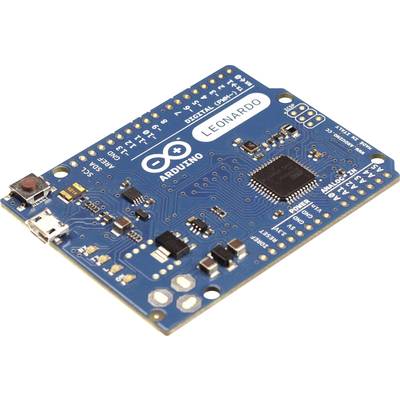
The Arduino Leonardo is a microcontroller board based on the ATmega32u4. It has 20 digital input/output pins (7 of which can be used as PWM outputs and 12 as analogueue inputs), a 16 MHz crystal oscillator, a micro USB port, a power supply jack, an ICSP header and a reset button. It contains everything was needed to support the microcontroller; simply connect it to a computer with a USB cable or supply it with an AC/DC adapter or a battery to get started. The Leonardo differs from all previous boards in that the ATmega32u4 has a built-in USB communication, which makes a second processor unnecessary. This allows the Leonardo to appear as a mouse and keyboard to a connected computer, in addition to a virtual (CDC) serial/COM port. It also has other effects on the behavior of the board; these are described on the Getting Started page.
This text is machine translated.
Description
The Arduino Leonardo is a microcontroller board based on the ATmega32u4. It has 20 digital input/output pins (7 of which can be used as PWM outputs and 12 as analogueue inputs), a 16 MHz crystal oscillator, a micro USB port, a power supply jack, an ICSP header and a reset button. It contains everything was needed to support the microcontroller; simply connect it to a computer with a USB cable or supply it with an AC/DC adapter or a battery to get started. The Leonardo differs from all previous boards in that the ATmega32u4 has a built-in USB communication, which makes a second processor unnecessary. This allows the Leonardo to appear as a mouse and keyboard to a connected computer, in addition to a virtual (CDC) serial/COM port. It also has other effects on the behavior of the board; these are described on the Getting Started page.
This text is machine translated.
What kind of Microcontroller Boards & Kits (MCU) are you looking for?