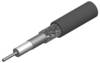
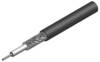
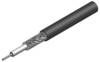
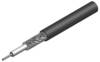
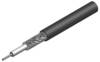
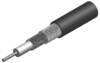
Specifications:
Surge impedance (impedance) 50 ohms or 75 ohms: In most applications, the 50 ohm system is used. However, in the transmission of video and audio signals and in long-term traffic technology, the 75 ohm system is normally used.,
Insertion loss (attenuation): The insertion loss describes the electrical signal losses along a cable. They are mainly determined by the cable diameter, the material of the dielectric and the frequency to be transmitted. Low-loss cables, for example, are characterized by particularly good, i.e. low values for insertion loss. Compared to an RG cable of the same size, the signal attenuation is much lower even at higher frequencies.
Shield attenuation: Shield attenuation describes how well the cable prevents the radiation or irradiation of HF signals along the cable. To improve shielding attenuation (i.e. to achieve higher dB values), double shielding braid, foil and braided shielding (low-loss cable) are used for cables and braided tin-Flex cables as an external conductor.,
Temperature range: Depending on the materials used, the cables can be used in different ambient temperatures. Cables with PE or PVC sheath can be used up to approx. 80°C, cables with PTFE or FEP sheath up to approx. 200°C and are also resistant to oil, UV radiation or chemicals.
Z 50 Ω
Fire protection class ECA
Burning drip: Not relevant
Smoke emission: Not relevant
Acid development: Not relevant
Cable group; Cable: G37
Cable jacket material:PE
Type: Low loss 400 FRLSZH, drum
2.7/7.3 AF, 2.7/7.3 CF, 213CRT7 LOW LOSS, 7810A, 9913, 9914, AIRCOM PREMIUM, C2FCP, C2FP, CNT-400, EC 400, HPF 400, HPL50-3XF, KSR400, LMR-400, MRC 400 AFB, RF 400 TT, SPEEDFOAM 400 HFJ, TZC 500 32, WBC-400, WCX400
Without cable group: Low Loss 400
Packaging unit (m): 500
Cable sheath Ø 10.16
Damping dB/100 m at 2 GHz 20
This text is machine translated.