Number
Highlights & Details
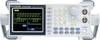
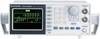
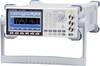
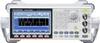
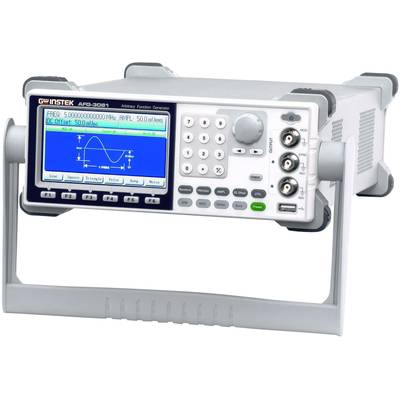
AFG-3000 Series Arbitrary Function Generator
- Wide frequency range from 1uHz to 80/50MHz
- High 200MSa/s sampling rate
- 16-bit Amplitude Resolution
- Output from any section of 1M-point-long waveform
- 4.3" high-resolution LCD display/on-screen help/Impedance switch
- Four ways to generate arbitrary waveform: Front Panel Operation
- CSV file uploading, Direct Waveform Reconstruction (DWR), Arbitrary
- Waveform Editing PC Software
- USB, RS-232, GPIB interface support
Technical specifications
- Vertical resolution: 16 bits
- Signal output type
Sine, square, pulse, arbitrary
- Frequency range
1 µHz - 50 MHz
- Frequency range (sine)
1 µHz - 50 MHz
- Frequency range square wave
1 µHz - 50 MHz
- Square wave slew rate
8 ns
- Frequency range triangle
1 µHz - 50 MHz
- Dim
(W x H) 265 mm x 107 mm
- Weight
4 kg
- Height
107 mm
- Width
265 mm
- Max. frequency
50 MHz
Manufacturer's standards (no certificate)
- No. of channels
1-channel
- Display
LCD
- Interfaces
GPIB
RS232C
USB
- Voltage supply
Mains
- Signal output types
Sinus
Rectangle
Pulse
Arbitrary
- Type
AFG-3051
- Min. frequency
1 µHz
- Product type
Mains-powered
Documents & Downloads
Datasheet
Datasheet 2108591 GW Instek AFG-3051 Mains-powered 1 µHz - 50 MHz 1-channel Sinus, Rectangle, Pulse, Arbitrary
User & Safety Instructions
User & Safety Instructions 2108591 GW Instek AFG-3051 Mains-powered 1 µHz - 50 MHz 1-channel Sinus, Rectangle, Pulse, Arbitrary
Description
The AFG-3000 Series also provides a high 16-bit resolution, 200MSa/s sample rate and a 1M memory depth for editing arbitrary waveforms directly through the intuitive user interface. The Direct Waveform Reconstruction (DWR) function enables users to directly import waveforms from a GDS-2000 Series oscilloscope to the AFG-3000 via USB host, allowing users to edit waveforms and enhance measurement efficiency.
In addition, the AFG-3000 Series has switchable 50 Ohm and Hi-Z Impedances, built-in On-Screen Help for operation conveniently. Complete parameter settings and waveform can be displayed through 4.3-inch high-resolution TFT LCD. Through USB, RS-232, and GPIB, users can use dedicated PC software or IEEE488.2 commands to edit waveforms.